

Last Updated: October 26, 2026
Quick Summary
Choosing Tacoma upper control arms starts with measuring your actual lift height and matching the arm design to how you drive. Most owners don't need new arms until they pass roughly 2 inches of lift, where caster correction becomes necessary. At 3 inches, aftermarket arms restore caster range and correct ball joint angle.
- Measure hub-to-fender lift, not the advertised kit height, before buying arms.
- Ball joint arms suit daily drivers and overlanders; uniball arms suit hardcore off-road builds.
- Confirm model year range, drivetrain, and coilover setup before ordering.
- Ask for an alignment printout showing caster, camber, toe, and thrust angle.
- Re-torque fasteners and recheck alignment after the first few hundred miles.
Table of Contents
- Start With Lift Height and How You Actually Drive
- Tacoma Upper Control Arm Fitment by Year and Generation
- Ball Joint vs Uniball Upper Control Arms
- Tacoma Upper Control Arms for 3-Inch Lift: What Changes
- Coilover, Tire, and Wheel Clearance: The Specs That Decide Fit
- Tacoma Upper Control Arm Maintenance and Failure Symptoms
- What It Really Costs to Own a Set of Aftermarket Arms
- Match Your Tacoma to the Right Set at Adventure Essentials
- Frequently Asked Questions
Start With Lift Height and How You Actually Drive
Choosing Tacoma upper control arms starts with two numbers and one honest answer: how much lift you're running, and how hard you actually drive. At Adventure Essentials, we see more fitment problems caused by mismatched lift height than by any other factor. A stock-height truck and a 3-inch-lifted build need different geometry, and a daily driver needs different bushings than a rock crawler.
Stock suspension arms work fine at factory height. Once you add lift, the alignment range shrinks and caster goes out of spec. Aftermarket arms restore that range.
Stock Height and Mild-Lift Setups
If your Tacoma sits at stock height or you're running a small leveling kit, you may not need new arms at all. Many owners stay on factory arms until they pass roughly 2 inches of lift, where caster correction becomes necessary.
For a deeper look at how lift height shapes the whole suspension package, read our guide to the best suspension for Tacoma overlanding.
The Decision Tree: Lift, Use, Budget
Use this order of operations before you buy:
- Measure your actual lift. Not the advertised kit height. Measure hub-to-fender.
- Define your use. Daily driving, overlanding, rock crawling, or desert running.
- Set a budget that includes alignment and installation, not just the arms.
- Match the arm design to the lift and use case.
- Verify fitment against your model year and trim.
Most buying mistakes happen when someone skips step one.
Tacoma Upper Control Arm Fitment by Year and Generation
Fitment is where online orders go wrong. The Tacoma spans multiple generations, and the 2024+ trucks use a different platform than the 2005-2023 models.
Always confirm three things before ordering: model year range, drivetrain, and whether your truck runs stock or aftermarket coilovers. A seller who lists "2005-2023" is telling you the arms fit that whole run. A seller who lists "2024+" is telling you something different.
We publish year-specific fitment tags on every product page for exactly this reason.
Ball Joint vs Uniball Upper Control Arms
Ball joint arms use a sealed, rebuildable joint. Uniball arms use a spherical bearing that offers more articulation but requires more attention.
Ball joint upper control arms are the practical pick for daily drivers and overlanders. They seal out debris and last a long time.
Uniball upper control arms suit hardcore off-road builds where maximum articulation matters more than service intervals.
If you want to see a ball joint design in detail, our 4130 upper control arms show the sealed Pro 4 joint and SilentSpin bushings. If a uniball-style arm fits your build better, view the billet upper control arm option and its specs.


Tacoma Upper Control Arms for 3-Inch Lift: What Changes
At 3 inches of lift, geometry changes the most. If you're weighing how much lift and travel to run, our long travel vs mid travel suspension comparison can help you decide. Caster drops, the alignment range narrows, and the stock arms run out of adjustment. This is the lift height where aftermarket arms earn their price.
Caster correction is the main job. Without it, the truck wanders and steering feels vague. Aftermarket arms add adjustment range so an alignment shop can bring caster back into spec.
What Actually Changes at 3 Inches
Lifting the front of a Tacoma pushes the upper control arm through a different arc. Three things follow:
- Positive caster falls away. Factory arms have a narrow adjustment window; once lift pushes caster below spec, the steering loses self-centering and the truck tracks ruts.
- The ball joint sits at a steeper angle. At full droop the joint approaches the edge of its travel, which is where boots tear and joints wear early.
- Camber and toe drift. Toe changes as the suspension cycles, so a truck that aligned fine at stock height can feel darty at 3 inches even with the same tires.
Aftermarket arms solve the first problem by adding caster range at the pivot, and the second by reshaping the ball joint angle for the lifted arc. They do not fix a bad alignment tech, which is why the post-install steps below matter as much as the part.
Alignment Targets and Post-Install Checks
After installation, get a professional alignment, and ask for the printout, not just a verbal "it's in spec." A printout gives you before-and-after numbers you can compare if the truck starts to wander later.
What to ask the shop to measure and record:
- Caster, both sides. Ask for the actual numbers, not a green checkmark. A common pattern is to run caster toward the higher end of the factory range on a lifted truck to restore straight-line stability, but the right figure depends on your tire size and how the truck is loaded.
- Camber, both sides. Large left-to-right splits point to a bent component or a worn joint, not an adjustment problem.
- Toe, total and per side. Toe is the setting most likely to drift after a lift, and it is the one that chews tires fastest when wrong.
- Thrust angle. If the rear axle is not square to the front, the truck will dog-track no matter how good the front alignment is.
Then do the follow-up work:
- Re-torque every fastener after the first few hundred miles. New arms settle, and a joint that was tight at install can loosen once the suspension cycles.
- Recheck alignment after that same break-in period, and again after any change to tire size, coilover preload, or added weight like a bumper and winch.
- Inspect the ball joint boots at every oil change. A torn boot is cheap to catch early and expensive to ignore.
Coilover, Tire, and Wheel Clearance: The Specs That Decide Fit
Clearance is the spec that quietly kills builds. Three numbers decide whether an arm works with your wheel and tire setup: maximum backspacing, minimum rim size, and coilover compatibility.
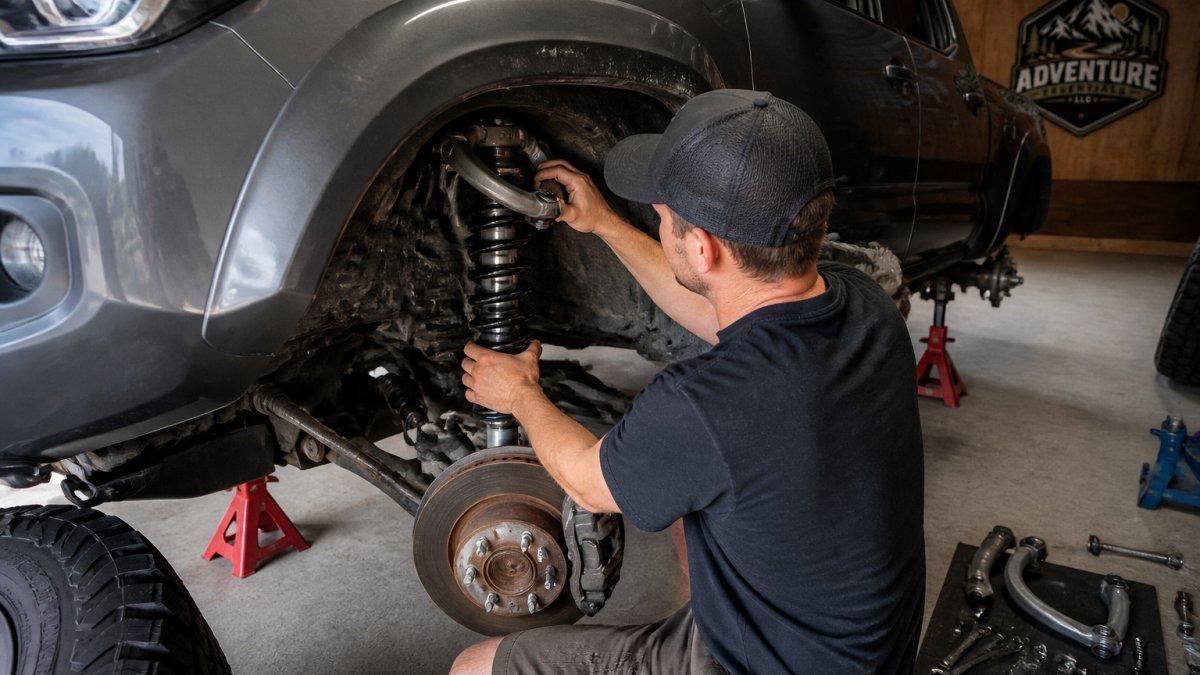
Check these before ordering:
- Maximum backspacing limits how far your wheel can tuck in.
- Minimum rim size rules out small-diameter wheels.
- Coilover compatibility confirms the arms work with your shock brand.
One warning we repeat often: do not combine coil spacers with extended-length aftermarket shocks on arms designed for coilover pairing. That combination pushes the joint past its intended range.
Tacoma Upper Control Arm Maintenance and Failure Symptoms
Even maintenance-free arms need inspection. Watch for clunking over bumps, uneven tire wear, vague steering, and torn ball joint boots. Any of these means it's time to look underneath.
Sealed bushings cut maintenance, but ball joints still wear over time. Our upper arm ball joint rebuild kit includes the joints, snap rings, castle nuts, and cotter pins needed to service compatible arms.

What It Really Costs to Own a Set of Aftermarket Arms
Total cost is more than the sticker price. Budget for the arms, a professional alignment, and installation if you're not doing the work yourself. Add a rebuild kit down the road. Most buyers compare sticker prices and stop there, which is why the ownership math below is worth running before you order.
Here's how the two main options compare on purchase price:
| Option | Price | Material | Bushings | Best For |
|---|---|---|---|---|
| 4130 Upper Control Arms | $899 | 4130 chromoly steel | SilentSpin, maintenance-free | Daily drivers, overlanding, 0-3" lift |
| Billet Upper Control Arms | $1,449 | 6061 aluminum | SilentSpin, maintenance-free | Builds wanting adjustable pivots and a refined finish |
The Costs Beyond the Sticker
Purchase price is the first line, not the last. Plan for these line items:
- Professional alignment. A four-wheel alignment is a routine shop charge and is not optional after installing arms. Budget for it once at install and again after the break-in recheck.
- Installation labor. If you are not doing the work yourself, expect a shop to charge by the hour. The job is not long, but it requires the truck on a lift and a torque wrench on every fastener.
- Rebuild kits. Both arm designs here are rebuildable. A rebuild kit with joints, snap rings, castle nuts, and cotter pins costs far less than a new set of arms, and it is the reason these arms spread their cost over years rather than one replacement cycle.
- Inspection time. Sealed bushings cut maintenance, but ball joints still wear. Plan on a visual check at every oil change and a closer look if you hear clunking.
How the Math Works Out
A common pattern among owners who keep a truck for years is that the arms are the smallest part of the total.
That reframes the value question. The cheaper arm is not the one with the lower sticker; it is the one that needs the least service and holds its alignment. Both sets here are rebuildable, which spreads the cost over years of use.
Match Your Tacoma to the Right Set at Adventure Essentials
The right arms come down to lift height, use, and fitment, in that order. Get those three right and the rest is straightforward.
At Adventure Essentials, we're an authorized Dirt King dealer, and our shop by vehicle, model, and year tool makes it easy to confirm fitment before you order.
Get started with Adventure Essentials and build your next adventure on components matched to your exact truck.
Frequently Asked Questions
Do I need upper control arms for a 3-inch lift on a Tacoma?
At 3 inches, stock arms usually run out of adjustment range, so caster and camber fall outside spec and the ball joint sits at a harsh angle. Aftermarket Tacoma upper control arms restore alignment range and add roughly an inch of down travel. Adventure Essentials lists 4130 and billet arms that both cover 0-3 inches of lift, so a 3-inch setup sits at the top of their stated range rather than beyond it.
What is the difference between ball-joint and uniball upper control arms?
Ball-joint arms use a sealed or rebuildable joint, which keeps road noise down and needs little attention. Uniball arms use a spherical bearing that allows more articulation for hard off-road use but transfers more vibration and needs periodic inspection. For a truck that sees daily driving plus weekend trails, a sealed ball-joint arm is the easier long-term choice. Adventure Essentials stocks rebuild kits with Moog ball joints for 2005-2023 Tacomas at $94.
How do I verify Tacoma upper control arm fitment by year and generation?
Confirm three things before ordering: your model year and generation, your current lift height, and your wheel specs. A 2005-2023 Tacoma takes a different arm than a 2024+ truck, and wheel backspacing limits matter too. The 2005-2023 4130 arms allow up to 4.75 inches of backspacing with a 16-inch minimum rim, while the 2024+ version allows 5.75 inches with a 17-inch minimum. Check all three against your build before you add to cart.
What maintenance do aftermarket Tacoma upper control arms need?
It depends on the joint. Greaseable joints need regular lubing, and uniballs need cleaning and inspection for play. SilentSpin bushings on Adventure Essentials arms are maintenance-free, with no grease fittings and no squeaks. Even so, check ball joints for play and torn dust caps at every oil change, and watch for uneven tire wear, which signals alignment has drifted. Rebuild kits are available when joints wear out.
