

Table of Contents
- Long Travel vs Mid Travel Suspension: Key Differences at a Glance
- What Is Mid Travel Suspension?
- What Is Long Travel Suspension?
- Mid Travel Suspension Benefits for Daily Drivers and Trail Rigs
- Long Travel Suspension Cost: What to Budget Beyond the Kit Price
- Daily Driving with Long Travel: What Changes on the Street
- Control Arms, Shock Tuning, and Geometry: The Hidden Trade-Offs
- Installation, Maintenance, and Legal Considerations
- Frequently Asked Questions
Last Updated: October 21, 2026
Long Travel vs Mid Travel Suspension: Key Differences at a Glance
The core difference between long travel and mid travel suspension comes down to wheel travel, track width, and how much of your truck you are willing to change. Long travel kits push wheels outward and stretch articulation well past stock, while mid travel suspension keeps geometry closer to factory.

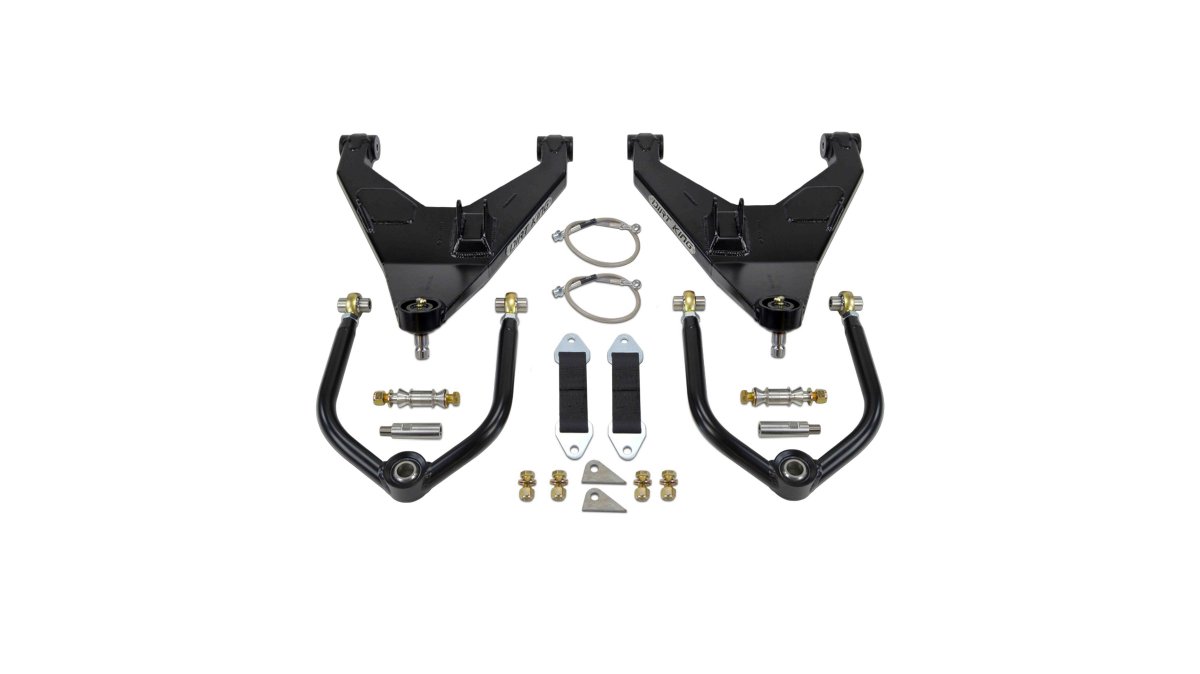
Here is what most buyers get wrong: travel numbers alone do not tell you which kit is better. A kit that adds travel by widening the truck four inches per side solves one problem and creates three others, because track width, steering geometry, and tire clearance move together.
Quick Comparison Table
| Factor | Mid Travel Suspension | Long Travel Suspension |
|---|---|---|
| Wheel travel gain | Modest, near-stock geometry | Large, often double stock |
| Track width change | Minimal to none | 2 to 4+ inches wider per side |
| Fender requirements | Usually stock fenders | Often fiberglass or trimming |
| Best terrain | Trails, overlanding, daily driving | Desert, high-speed, rock crawling |
| Drivetrain stress | Low | Higher, especially on 4WD |
| Installation | Bolt-on in most cases | Bolt-on to fabrication depending on kit |
| Typical budget | Lower | Higher, plus supporting parts |
What Is Mid Travel Suspension?
Mid travel suspension increases wheel travel moderately while keeping geometry close to factory, so the truck stays comfortable and predictable on the street. It typically pairs upgraded upper control arms with quality coilovers and leaves the lower mounting points stock.
Keeping the lower arms in the factory position preserves ground clearance and keeps bump steer manageable, so you get better articulation and a smoother ride over washboard and rocks without turning your daily driver into a project.
A common approach adds a couple inches of width per side and bumps travel by roughly a quarter while staying compatible with stock fenders, the sweet spot for a truck that commutes weekdays and hits trails on weekends.
What Is Long Travel Suspension?
Long travel suspension extends the control arms and relocates suspension mounting points to deliver significantly more wheel travel and track width than stock, keeping tires planted at speed over rough ground.
Kits in this class vary widely. A race-spec kit can reach 17.5 inches of travel with 4.25 inches of added width per side.

Larger travel means longer shocks, extended brake lines, and on 4WD trucks, extended axle shafts or machined CVs.
Mid Travel Suspension Benefits for Daily Drivers and Trail Rigs
Mid travel suspension benefits show up fastest in the places you actually drive: the truck tracks straight on the highway, the ride over broken pavement improves, and washboard forest roads stop being a dread.
Here is what owners notice first:
- Ride quality improves because a properly valved coilover absorbs sharp impacts that stock shocks pass straight to the frame.
- Trail capability rises without changing how the truck parks or fits in a garage.
- Tire wear stays even because alignment specs remain close to factory.
We recommend mid travel for overlanders who cover long highway miles to reach remote trailheads. The gains are real, the compromises are small, and you keep the truck you bought.
Long Travel Suspension Cost: What to Budget Beyond the Kit Price
Long travel suspension cost is where budgets quietly fall apart. The kit price is only the entry fee, and supporting parts often rival it.
Start with the kit itself. In our catalog, a Dirt King long travel kit for the Nissan Titan runs $3,299.00, the Ram 1500 kit runs $3,699.00, and the Toyota Tacoma +2 kit runs $3,499.00. A complete LT PreRunner Kit for Chevy and GMC trucks runs $12,793.99 because it bundles coilovers, bypass shocks, a bed cage, leaf springs, and axle assemblies.

Then add the parts nobody quotes upfront:
- Shocks built to the kit's spec, since off-the-shelf units will not deliver full travel
- Extended brake lines and limit straps, usually included but worth confirming
- Fiberglass fenders or wheel well modification for wider track width
Daily Driving with Long Travel: What Changes on the Street
Daily driving with long travel is more livable than the internet suggests, but not invisible. A well-built kit keeps the truck stable and comfortable; a poorly matched one makes every on-ramp feel like a suggestion.
The honest trade-offs:
- Wider track width means a larger turning circle and more attention in tight parking lots.
- Bump steer appears if the kit's geometry is not corrected, which is why quality kits relocate steering pickup points.
- Tire choice matters more. A 35-inch mud tire on a long travel truck hums on the highway in a way a 33-inch all-terrain does not.
Our take: if more than half your miles are on pavement, mid travel is the better call. If the truck lives for desert weekends, long travel earns its compromises.
Control Arms, Shock Tuning, and Geometry: The Hidden Trade-Offs
Control arms, shock tuning, and suspension geometry decide whether a kit feels dialed or twitchy. Travel numbers sell kits; geometry makes them work, and determines whether your truck drives straight at 75 mph or wanders when the pavement breaks.
What the control arms actually change
Upper and lower control arms define the camber curve and caster as the suspension cycles. Longer arms flatten that curve, keeping the tire contact patch consistent through travel, which is why quality kits use boxed plate construction, uniballs or heavy-duty ball joints at the outer pivots, and Delrin or SilentSpin bushings at the inner pivots. On a mid travel kit, only the upper arm is replaced, so the camber curve changes modestly.
Bump steer: the mechanism, not just the buzzword
Bump steer is toe change as the suspension compresses, because the steering tie rod and control arms swing on different arcs. Add travel or change arm length and those arcs diverge further, so the tire toes in or out as the suspension moves.
The fix is geometric. Quality long travel kits relocate the steering pickup points (often with a corrected spindle or bump-steer kit) so the tie rod arc matches the control arm arc.
Scrub radius and why wider track changes steering feel
Scrub radius is the distance between the steering axis (drawn through the upper and lower ball joints) and the center of the tire contact patch.
This is why long travel kits are not just "wider mid travel kits." Good ones correct scrub radius through spindle design or wheel offset recommendations; cheap ones leave you with heavy steering and a truck that follows every crack in the road.
Alignment: the spec sheet nobody hands you
Factory alignment specs assume factory geometry. Once you change arm length and track width, factory camber and caster numbers may be unreachable without aftermarket camber kits or slotted mounts. Long travel trucks commonly need a custom spec, more negative camber and more positive caster than stock, to keep the contact patch flat through travel. Ask the manufacturer for a recommended alignment sheet before you book the shop.
Shock tuning is the other half
Damping has to match the spring rate and vehicle weight, or the truck will pogo over chatter and wallow in whoops. Bypass shocks let you fine-tune damping through the travel cycle, which is why serious desert builds run them; bump stops are the cost-effective alternative, though noisy. The key point for long travel vs mid travel: a long travel kit's advertised travel assumes shocks built to its spec, so the shock budget belongs in the kit decision, not after it.
Installation, Maintenance, and Legal Considerations
Installation difficulty ranges from a weekend bolt-on to a job for a qualified off-road shop, and the kit tells you which. Bolt-on applications with no frame cutting are realistic for a confident DIY builder; kits requiring welding shock hoops, replacing coil buckets, or machining CVs are not. What really separates a happy long travel owner from a regretful one is long-term maintenance cost and street legality, and most comparison articles skip both.
Installation: what the bolt-on label really means
A "bolt-on" long travel kit still means a full day or more for a competent DIYer: disconnecting the factory suspension, swapping arms, mounting coilovers or bypass shocks, extending brake lines, and setting ride height. Add a second day for fiberglass fenders and an alignment. Kits requiring welding or frame cutting move into shop territory, and shop labor for a full long travel install commonly runs into four figures on top of the kit price.
Long-term maintenance: the cost nobody quotes upfront
Long travel suspension uses more wear-prone components and cycles them harder, so the rebuild cadence is shorter and the parts bill is higher over the truck's life.
- Uniballs and heims at the outer pivots wear and develop play. They are consumables, not lifetime parts, and they need replacement on a schedule that depends on dirt and mileage.
- Coilovers and bypass shocks need rebuilding. A common pattern is a rebuild interval measured in tens of thousands of miles for a daily-driven truck, shorter for a truck that sees hard desert use. Bypass shocks add more seals and more service points than a simple coilover.
- Bushings at the inner pivots degrade, and Delrin or polyurethane bushings are replaced more often than factory rubber.
A mid travel kit shares some of these costs at lower frequency and lower parts cost, because it cycles stock-location components less aggressively. If you plan to keep the truck past 100,000 miles, budget an annual suspension maintenance line item for long travel and a smaller one for mid travel.
Legal and insurance implications of a wider track
Long travel kits widen the track 2 to 4+ inches per side, and that change has real-world consequences off the trail:
- State equipment rules. Many states regulate tire coverage and fender requirements, tires protruding beyond the fenders can fail inspection or draw citations. Fiberglass fenders are often the compliance fix, not just a style choice.
- Lift and modification statutes. Some states cap suspension lift height or require modified-vehicle inspection. Track width changes can also affect how a vehicle is classified.
- Insurance. Carriers may treat a modified suspension as a material change to the vehicle. Some will cover it if disclosed; others may limit coverage or decline a claim tied to the modification. Disclose the kit to your insurer before install, not after a claim.
Check your state's vehicle equipment requirements and talk to your insurer before you install, a truck that fails inspection or loses coverage is a worse outcome than a stock one.
Frequently Asked Questions
What are the downsides of long travel suspension?
Long travel suspension increases track width by 2 to 4.25 inches per side, which can stress ball joints, tie rods, and CV axles over time. It also requires extended brake lines, limit straps, and often wheel well modifications for larger tires. Daily driving with long travel may feel looser on-center, and tire wear can accelerate without proper alignment. Maintenance intervals for shocks and uniballs are shorter than stock, and the upfront cost runs from $3,299 to $12,793.99 depending on the kit and vehicle.
Is mid travel suspension good for daily driving?
Yes. Mid travel suspension benefits include retaining near-stock geometry and ride quality while adding articulation for trails. Because it typically keeps the factory track width or adds only a small amount, steering feel and tire wear stay close to stock. Most mid travel setups work with original control arm mounting points and do not require extended axle shafts. If your truck spends weekdays on pavement and weekends on forest roads, mid travel is the more practical choice.
How does long travel suspension cost compare to mid travel?
Long travel suspension cost starts higher because the kit includes longer control arms, extended brake lines, limit straps, and often requires custom-valved shocks. At Adventure Essentials, long travel kits range from $3,299.00 for a Nissan Titan kit to $12,793.99 for a complete Chevy/GMC PreRunner system. Budget another $1,000 to $3,000 for installation, alignment, and tires if needed. Mid travel kits generally cost less but deliver a smaller gain in wheel travel.
Do I need aftermarket control arms for a mid travel setup?
Most mid travel setups use aftermarket upper control arms to correct camber and caster after lifting, and some include replacement lower arms for added strength. The stock lower arms can work if lift is modest, but they limit droop and may not clear larger shocks. For a long travel kit, both upper and lower control arms are replaced because the pivots and length change. Always confirm fitment by vehicle year, make, and model before ordering.
How does long travel suspension impact vehicle width and handling?
Long travel kits widen track width by 2 to 4.25 inches per side, which improves stability in corners and on off-camber terrain but can cause tire rub on stock fenders. The wider stance also changes scrub radius and bump steer, so alignment and steering geometry corrections are necessary. On the street, the added width makes parking tighter and may require fender flares for legal coverage. Handling feels more planted at speed but less precise at low speeds until the suspension is properly tuned.